


The Myanmar junta’s aviation fuel trade fraud exposed
October 26, 2026
The illegal Myanmar military junta, and a network of companies linked to it, have been committing trade fraud by intentionally misdescribing and misclassifying aviation fuel as high-speed diesel, and by using proxy companies to hide the cargo, importers and the sources of funds. Between December 2024 and November 2025, Justice For Myanmar identified records for six imports of aviation fuel that used these evasive measures. The six imports covered more than 843,000 barrels of aviation fuel valued at US$109.5 million. The records are from a junta commerce ministry data leak.
The import documentation reveals a network of junta-linked businesses in Myanmar, Thailand and the United Arab Emirates (UAE), for fuel declared as originating in or transiting through Singapore and South Africa.
This adds to an array of evasive tactics that have been documented in the junta’s aviation fuel supply chain in response to sanctions and reporting on the complicity of aviation fuel suppliers in the junta’s commission of war crimes through airstrikes. For instance, US-sanctioned vessels from Iran’s “shadow fleet” that go dark when onloading or offloading have delivered aviation fuel to Myanmar in 2024 and 2025 and cargo has been resold and transhipped multiple times, hiding the source, according to Amnesty International.
The Myanmar junta relies on a continuing supply of jet fuel to sustain its aerial campaign of terror against the people. Attacks on civilians and civilian objects since the military’s coup attempt have been repeatedly investigated and reported to be deliberate and indiscriminate, constituting war crimes. As it has lost ground to resistance forces, the junta has increased airstrikes that slaughter civilians across Myanmar and destroy schools, hospitals and religious buildings, committing international crimes with total impunity.
Airstrikes remained the leading cause of civilian casualties in Myanmar in 2025. The UN Human Rights Office (OHCHR) recorded a more than 50% rise in airstrike deaths compared to 2024. At least 641 civilians were killed by airstrikes in 2024. In 2025, the figure reached 982, including 368 women and 232 children, which is more children than were killed by airstrikes in the previous four years combined. During the voting period of the junta’s sham election, from December 2025 to January 2026, the junta killed a reported 170 civilians in 408 aerial attacks. In the lead-up to the sham election, on December 10, 2025, junta aircraft attacked the Mrauk-U general hospital, killing at least 33 civilians and injuring more than 70, including doctors, nurses and patients. It was the deadliest recorded attack on a healthcare facility in Myanmar since 2021. These airstrikes depend on an apparatus of personnel, aircraft, munitions, repair and maintenance services, and aviation fuel.
Justice For Myanmar calls on Thai, Singaporean and Emirati authorities to urgently investigate the junta’s trade fraud and use of companies in their territory to source aviation fuel. The junta’s trade fraud risks destabilising bordering countries; increases the risks of secondary sanctions and of assets being frozen by countries with relevant autonomous sanctions; increases the cost and complexity of due diligence requirements on companies and financial institutions; and increases the risk the same practices will be used for imports of illicit goods. For the countries involved, this requires a strong response for the sake of their own domestic regulations and financial integrity.
For the governments of the Association of Southeast Asian Nations (ASEAN) and other countries in the region, the Myanmar military’s trade fraud only increases the risks that the same methods and actors will take advantage of the same loopholes to import other prohibited goods. We call on ASEAN, its members and other governments in the region to address the regulatory and policy risks posed by the junta’s practices, including by refusing to legitimise it, and to support the Myanmar people’s struggle for federal democracy.
Companies in the aviation fuel supply chain into Myanmar have been exposed to autonomous sanctions from the USA, UK, EU, Canada and Australia since early 2023. The methods found in the import documentation for aviation fuel imports between December 2024 and November 2025 show a multilayered effort to take advantage of the gaps in these sanctions.
In August 2023, the USA issued a determination authorising sanctions against any company or individual that operates in the jet fuel sector of the Myanmar economy, including through activities related to the “importation, exportation, reexportation, sale, supply, or transport, directly or indirectly, of jet fuel”. The determination was a positive step that increased sanctions risks for those operating across the junta’s aviation fuel supply chain. However, since the designations announced alongside the determination in August 2023, the USA has not imposed further sanctions on the junta’s aviation fuel supply chain. More action is needed now to block the junta’s ability to source aviation fuel and continue to carry out deadly airstrikes.
Justice For Myanmar demands the USA, UK, EU, Canada and Australia impose new targeted sanctions on the junta itself, following its rebrand from the previously sanctioned State Administration Council, and sanction the junta’s whole aviation fuel supply chain network, including the companies and individuals identified in this investigation. The policy aims of existing sanctions cannot be achieved without a comprehensive ban on aviation fuel exports to Myanmar.
Unravelling the junta’s trade fraud
Justice For Myanmar identified the imports of aviation fuel, mislabelled as high-speed diesel, in documents filed with the trade department of the junta’s commerce ministry, which authorises imports. All followed a common typology of trade fraud. The import documents examined include letters, contracts, invoices, company extracts, decisions from the junta’s Foreign Exchange Supervisory Committee (FESC), and import permits issued by the junta’s commerce ministry. Stated delivery periods ranged from one to three months and included the window when the junta was holding its sham election. Records of vessel arrivals at the Myan Oil aviation fuel terminal, obtained by Justice For Myanmar and cross-checked against junta port statistics, show aviation fuel arriving during 2025 for both companies named as buyers in the contracts, Dynamic Wave and PP Petroleum.
The junta’s trade fraud is further evidenced by an analysis of price, fuel density and an examination of the corporate networks behind the imports.
The price in the invoices and contracts was artificial and did not correspond to the market rate for diesel or aviation fuel in the period. Genuine diesel imports into Yangon of the same grade, in records examined by Justice For Myanmar, followed the market rate with an average premium of 10% for delivery to Yangon, while the market price for aviation fuel tracked close to the diesel price at the time. In contrast, the six aviation fuel imports misdescribed as diesel were all priced at either US$129.50 or US$130 per barrel, despite market fluctuations. These prices contain an average 50% premium on the price of high-speed diesel, the commodity the cargoes were declared to be, which cannot be explained by freight and insurance costs.
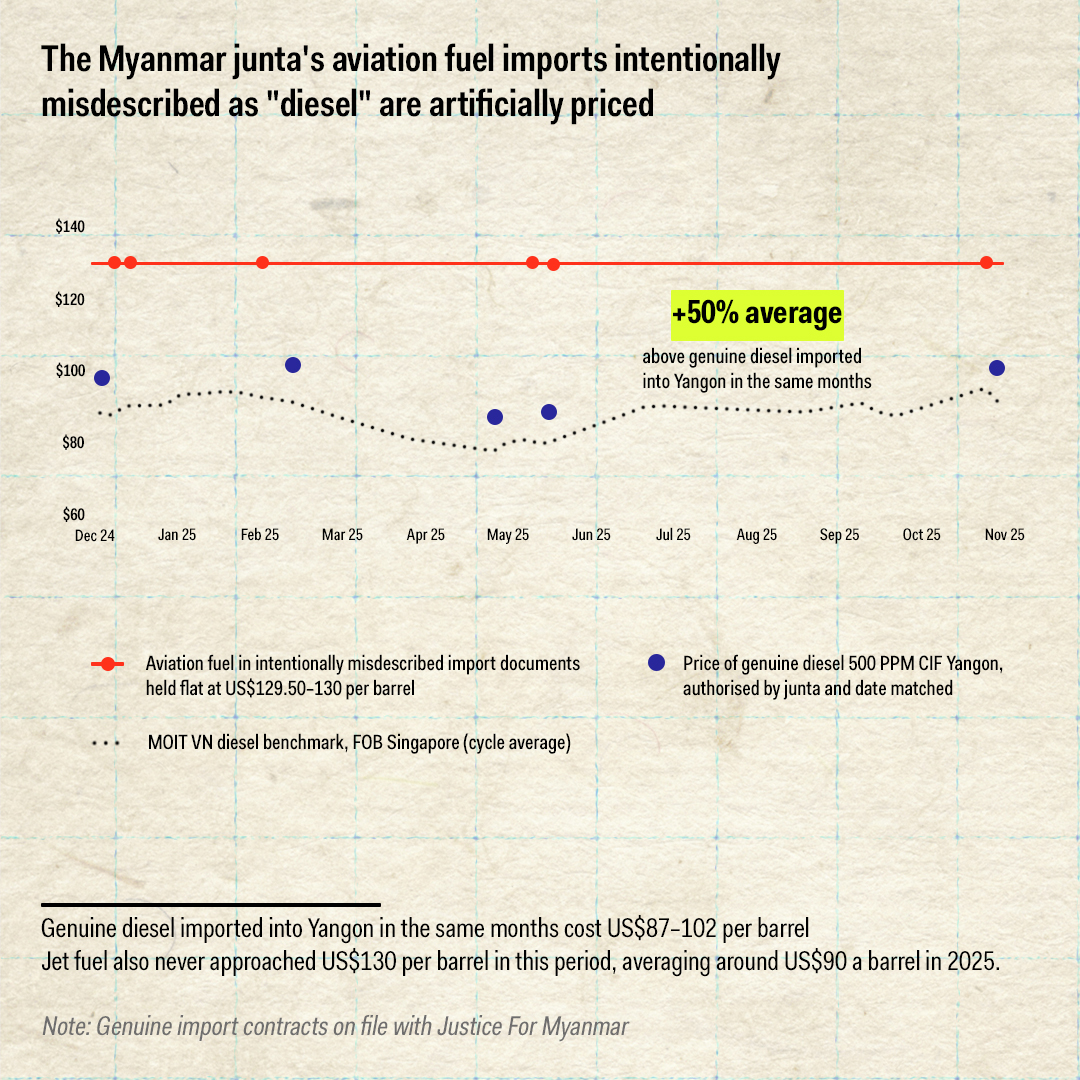
Justice For Myanmar has confirmed that no Myanmar tax benefit exists in misdescribing and misclassifying aviation fuel as high-speed diesel. Both commodities carry the same Myanmar customs tariff of 1.5% and are in the same Specific Goods Tax category of 5%. There must therefore be another motive for incurring the risk, inconvenience and expense of using commodity misdescription, proxy companies and shifting corporate structures. Aviation fuel attracts additional scrutiny, and the motive is likely to be evading international regulators, banks, insurance providers and other companies involved in the global aviation fuel supply chain that must minimise sanctions exposure risks.
The imports in the name of Dynamic Wave
Import documents show that three of the imports, priced at a combined US$68.49 million and totalling 527,624 barrels, were between the Myanmar junta-controlled joint venture National Energy Prime Aviation Services Company Limited (NEPAS) as buyer, through the proxy company Dynamic Wave, and the Thai company Tawan-Oil Trading as seller. NEPAS is 51% owned by Myanma Petrochemical Enterprise (MPE), formerly Myanma Petroleum Products Enterprise (MPPE), which is a state-owned enterprise illegally under junta control. NEPAS’ 49% shareholder is Prime Aviation Services Company Limited, part of a private network of companies that goes by names that include Myan Oil, Asia Sun and Shoon.
Prime Aviation Services, set up in October 2022, replaced a Singapore company from the same group, PEIA Pte. Ltd. (formerly Puma Energy Irrawaddy Aviation), which was sanctioned by the USA in 2023, along with its sister company P.E.I Energy Pte. Ltd., the beneficial owner of the Myan Oil aviation fuel terminal in Thilawa, Yangon. Both remain registered in Singapore. The sole director of Prime Aviation Services is Kyauk Kyar Shwe, who is also known as Khin Phyu Win, a key individual in the junta’s aviation fuel supply chain and who has been sanctioned by the USA, UK and Canada. She is also the owner of PEIA. Asia Sun companies have repeatedly changed their names and structures as pressure built on those involved in the junta’s aviation fuel supply chain. That pressure increased when the Asia Sun group was comprehensively exposed in 2022 by Amnesty International and Justice For Myanmar for supplying aviation fuel to the Myanmar air force, and was targeted for sanctions. An Asia Sun subsidiary has continued to deliver fuel to air force bases in 2026, according to evidence seen by Justice For Myanmar. While they have rebranded multiple times and use various names, including Myan Oil and Shoon, Justice For Myanmar has chosen to continue referring to the conglomerate as Asia Sun group.
NEPAS holds the primary investment commission licence for import, storage, distribution and transportation of aviation fuel, and its role supplying fuel to the Myanmar air force has been well documented. In January 2024, six US government agencies jointly warned that NEPAS and the then MPPE (now MPE) hold monopoly control over Myanmar’s aviation fuel sector, that jet fuel is “commingled… between military and civilian end users”, and that it is “currently impossible for suppliers to ascertain the end user” of aviation fuel supplied to Myanmar. While NEPAS and its state-owned enterprise shareholder MPE have not yet been sanctioned, a number of companies and key individuals associated with NEPAS’ private sector shareholder have been sanctioned. NEPAS’ private shareholder replaced its directors after Justice For Myanmar published their names in 2022. At least three new directors, Swin Tine Fu, Nu Nu and Thaung Nyunt, are named in the trade documents or corporate data. They may be used to avoid the companies having to use the remaining publicly exposed directors in trade documents, Yin Yin Aung, Tin Moe Oo and Tin Zaw Myint, all from MPE, so as to evade enhanced due diligence.
In all three imports that name Tawan-Oil Trading as the seller, a Myanmar proxy, Dynamic Wave Company Limited, is listed as the importer instead of NEPAS. The use of proxy companies is one of the evasive methods used by the junta and Myan Oil to import aviation fuel in response to sanctions. Dynamic Wave was registered in July 2024 with a sole director and shareholder, Ye Yint Aung, who does not appear to be connected to any other company. Dynamic Wave has not been previously exposed or sanctioned, so it is unlikely to have triggered red flags when compliance checks and other risk-management measures were carried out by actors involved in the global aviation fuel supply chain.
The most recent of the three authorised imports was in November 2025, with payment approved by the junta’s FESC. An official letter, addressed to NEPAS by the FESC and marked as confidential, relays the decision of an FESC meeting held on November 26, 2025. The FESC approved the payment of US$15.76 million for the import of 121,200 barrels of fuel. The letter authorises that the import licence be issued “under the name of diesel (HSD) instead of aviation fuel”, showing the junta’s role in commodity misdescription.
In the same letter, the FESC also authorised the import permit to be issued “in the name of Dynamic Wave on behalf of NEPAS”, showing the junta authorised import by a proxy company that concealed NEPAS as the actual buyer.
For payments, the FESC letter authorised that funds be transferred from NEPAS’ US dollar account to Dynamic Wave’s US dollar account, both at KBZ Bank. Although the transactions were denominated in US dollars, they may have been cleared through banks in the region rather than directly through US-based institutions. However, any involvement of US financial institutions, US correspondent accounts, or other US persons could create a US sanctions nexus and expose participants to sanctions compliance and enforcement risks. The FESC further authorised that those funds be paid to Tawan-Oil Trading or an affiliated company designated by it. The FESC letter is copied to the junta-controlled commerce ministry and central bank.
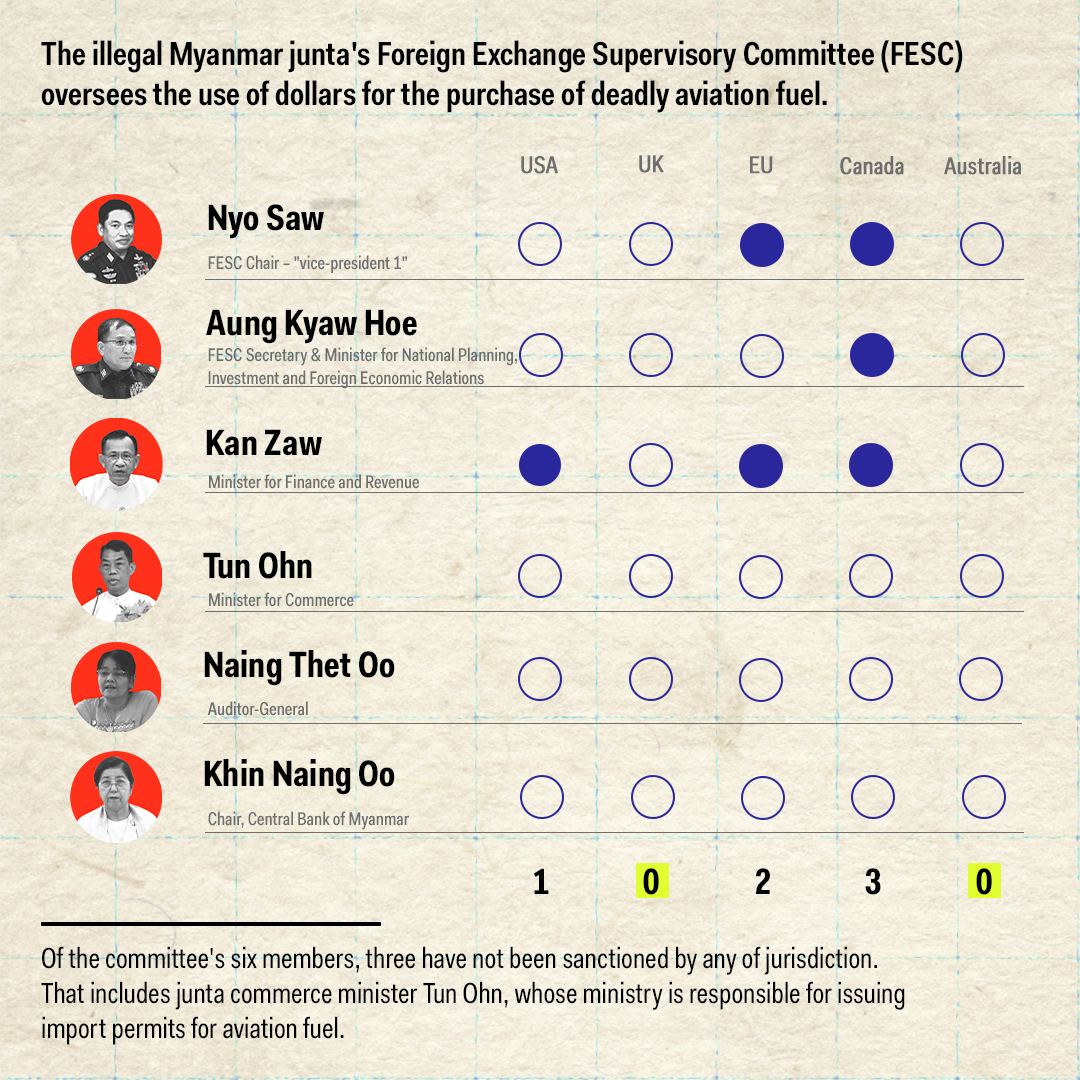
The FESC is a high-level body that the junta established in 2022 to control the use of foreign currency in global trade and investment. The committee has been reconstituted twice since its formation but has always consisted of six members, including the three junta ministers responsible for investment, finance and commerce; the junta auditor general; and the chair of the junta-controlled central bank. Since May 2024, the FESC has been chaired by the retired lieutenant general Nyo Saw, the junta’s “vice-president-1” and a former army quartermaster general who has played a central role in overseeing the military’s expansive business interests. The composition of the FESC, involving high-level junta members across key ministries and the central bank, demonstrates the institutionalisation of trade fraud as a method of importing aviation fuel.
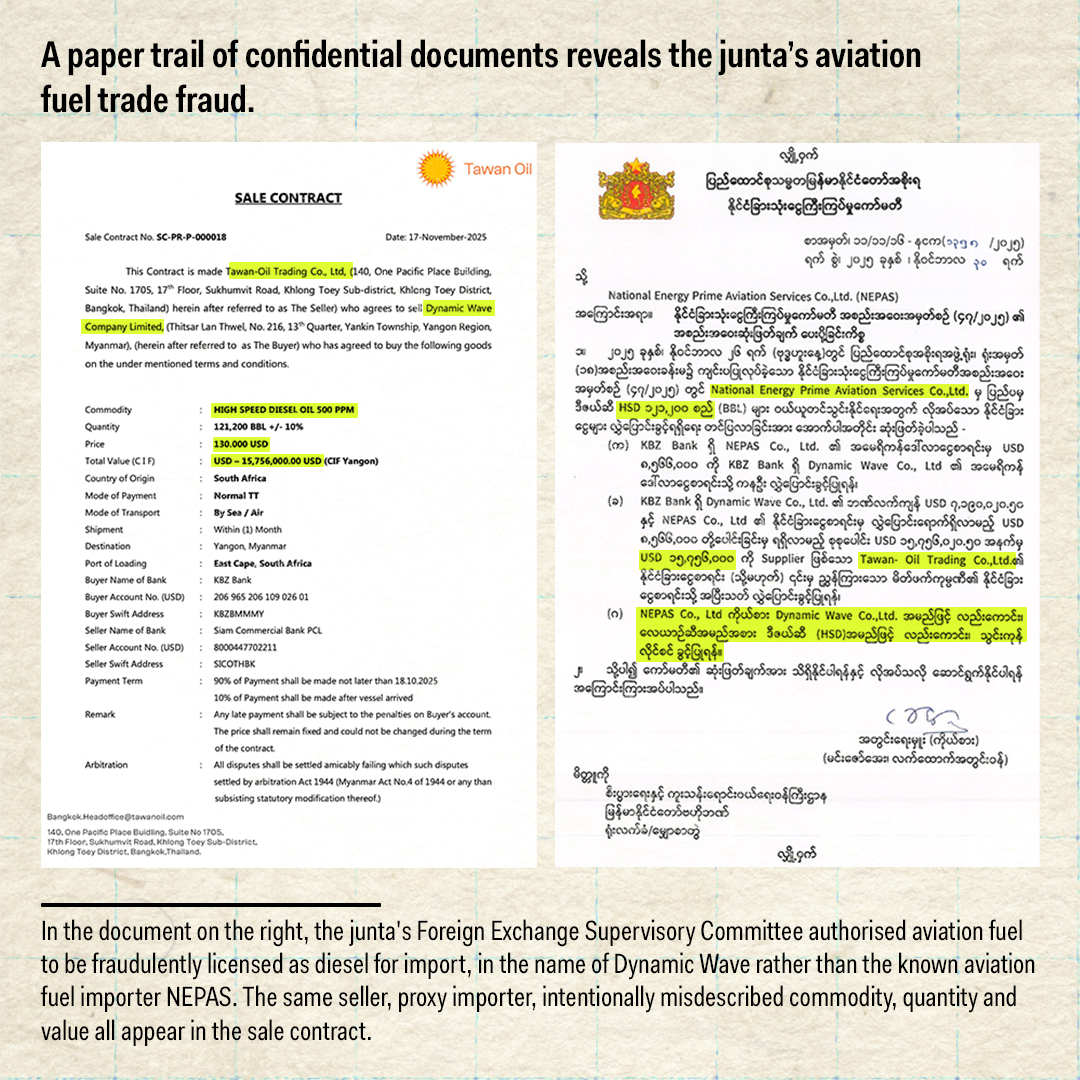
An associated sales contract between Tawan-Oil Trading and Dynamic Wave demonstrates that the role of NEPAS as the buyer is fully hidden. It describes the commodity as “high speed diesel oil 500 PPM”, consistent with the FESC letter, and lists South Africa as the country of origin and “East Cape” as the port of loading. Justice For Myanmar found no evidence confirming South Africa as the true origin of the fuel, suggesting it is listed to conceal the actual origin of the cargo. The document prices the fuel at US$130 per barrel, which is far above the market range for diesel, even when accounting for delivery to Yangon. The contract with Dynamic Wave lists Siam Commercial Bank as the bank holding Tawan-Oil’s account for the sale. Siam Commercial Bank has also been identified by the UN Special Rapporteur on Myanmar as facilitating transactions related to Myanmar military procurement.
The role of the FESC in the trade fraud scheme is also demonstrated in a second document for the purchase of 204,424 barrels priced at US$26.58 million. In a letter to NEPAS detailing the result of a February 5, 2025 meeting held in the office of the State Administration Council, the FESC instructs that the import licence be granted in the name of Dynamic Wave Co. Ltd., on behalf of NEPAS Co. Ltd. for high-speed diesel. Consistent with the November decision, the FESC authorised transactions between NEPAS and Dynamic Wave to consolidate funds in US dollars in Dynamic Wave’s KBZ account for payment to Tawan-Oil Trading or another company it designates. As NEPAS and Dynamic Wave did not have enough US dollars on hand, the FESC approved the purchase of over US$8 million from authorised dealer banks, naming KBZ Bank, UAB Bank, CB Bank and Myanma Economic Bank using the exchange rate that the junta designates for migrant worker remittances.
The FESC letters demonstrate that the aviation fuel is purchased by NEPAS and that the true importer is concealed through payments routed via Dynamic Wave, mirroring the layering stage of money laundering. In this case, the concealment is overseen by the junta’s own foreign exchange regulator.
A third Tawan-Oil Trading contract dated May 29, 2025, was for 202,000 barrels priced at US$26.16 million, also with Dynamic Wave named as the buyer on behalf of NEPAS. Like the November deal, the commodity is misdescribed as “High Speed Diesel Oil 500 PPM” and the origin is also listed as the “East Cape” of South Africa. The invoice specifies the fuel density as 0.795 kg per litre, below the minimum density for 500 PPM diesel according to the Platts specification for the Singapore market, and within the aviation turbine fuel specification range. The invoice misclassifies the cargo under Myanmar’s tariff code 2710.19.72.00 for “other diesel fuels”, rather than aviation fuel, which is under the codes 2710.19.81 and 2710.19.82. Myanmar’s tariff codes are based on the World Customs Organization Harmonized System (HS) and the ASEAN Harmonized Tariff Nomenclature. The price of US$129.50 per barrel is at least 47% higher than the price of genuine diesel imports into Myanmar in the same month, which ranged from US$86–88 per barrel. Additional shipping costs for cargo from South Africa cannot explain the premium over genuine diesel prices, and the price was almost identical to the rate in the other Tawan-Oil Trading imports.
Tawan-Oil Trading’s involvement in the three transactions came after its public identification in a report by the UN Special Rapporteur on Myanmar in June 2024 as one of two Thai businesses selling aviation fuel to other companies in the Asia Sun group. Despite this, the Thai government does not appear to have taken any action to prevent Tawan-Oil Trading’s continued role in the junta’s aviation fuel supply chain and the company has not yet been sanctioned. The UN Special Rapporteur disclosed that Kasikorn Bank was used in the earlier Tawan-Oil Trading transactions. Siam Commercial Bank and Kasikorn Bank did not respond to questions from Justice For Myanmar.
Justice For Myanmar has concluded that Tawan-Oil Trading is an Asia Sun shelf company based on its use of nominee shareholders, an analysis of its activities and the fact that it has a shared address and shared infrastructure with Asia Sun companies. Tawan-Oil Trading was incorporated in Thailand in 2020 as Gryfan Group Asia Company Limited for the wholesale of machinery and equipment for civil engineering, mining and construction with three foreign citizens as founding shareholders. In April 2023, three months after sanctions were first imposed on Asia Sun companies, the foreign shareholders transferred their stakes to two Thai nominee shareholders, Samart Saengnok and Netpairin Yuenyan. At the same time, the company changed its name to Tawan-Oil Trading and revised its objectives to add petroleum trading.
Tawan-Oil Trading registered its dissolution on August 13, 2024, 48 days after the UN Special Rapporteur on Myanmar named it as one of two Thai-registered companies that sold aviation fuel to Myanmar buyers controlled by NEPAS and the Asia Sun group. Following an intervention by the Revenue Office, more than two years on it still has not been wound up. In the eighth quarterly liquidation report, which is the most recent available and filed on August 17, 2026, the liquidator recorded the company as still in liquidation as at August 14, 2026. Under Thailand's Civil and Commercial Code, a company in liquidation may only conduct business as necessary to wind up its affairs. Yet in the three deals authorised between February and November 2025, six to fifteen months after it was dissolved and entered liquidation, Tawan-Oil Trading was party to contracts with Dynamic Wave, acting as the Myanmar proxy for NEPAS, for cargoes worth a combined US$68.49 million. This raises the question of how these transactions fell within the limited winding-up purpose required by law.
Justice For Myanmar has reported Tawan-Oil Trading to Thailand's Department of Business Development, the Revenue Department and the Anti-Money Laundering Office. We call on them to investigate the company's conduct and reporting during liquidation, and the suspected use of nominee directors and shareholders to conceal its ownership and the movement of funds through Thai banks.
The imports in the name of PP Petroleum
Justice For Myanmar identified documents for three additional imports valued at US$41.06 million that are assessed to be aviation fuel mislabelled as high-speed diesel. This is based on the junta’s pattern of commodity misdescription and misclassification, on pricing, and on the fact that the importer, PP Petroleum Company Limited, is also part of the Asia Sun group.
PP Petroleum was established in November 2022, three weeks after Asia Sun was publicly exposed by Amnesty International and Justice For Myanmar. The company’s registered sectors include food manufacturing and trading. PP Petroleum’s sole director and shareholder is Chit Htwe, who is also one of two directors of Myan Oil Terminal Company Limited (formerly Puma Energy Asia Sun Company Limited). The Asia Sun group company Myan Oil Terminal Company Limited is the owner and operator of Myanmar’s only dedicated aviation fuel terminal, Myan Oil Terminal at Thilawa, in Yangon, which plays a crucial role in the junta’s aviation fuel supply chain.
Chit Htwe is also the sole director and shareholder of Rich Ray Trading Company Limited (formerly Royal Rich Ray Company Limited). Rich Ray Trading was first identified by Justice For Myanmar in 2022 as part of an investigation into Asia Sun group. In June 2024, the UN Special Rapporteur on Myanmar identified Rich Ray Trading as a proxy of Asia Sun group and revealed that it had purchased aviation fuel through Tawan-Oil Trading and another Thai company, CB Energy. Myan Oil Company and Rich Ray Trading were sanctioned by the UK in October 2024 for their association with Asia Sun and for “making available economic resources (aviation fuel) directly or indirectly to or for the benefit of the Myanmar security forces”.
Import documents for the three PP Petroleum cargoes show two deals contracted in December 2024, one valued at US$14.98 million and a second valued at US$20.80 million that the junta licensed in January 2025, followed by a third in May 2025 valued at US$5.28 million. In each of the three, aviation fuel was misdescribed as “high-speed diesel”. The documents for the three imports list Singapore as the port of loading, which is consistent with the documented roleof Singapore as a business hub for aviation fuel supplies to Myanmar. Based on NEPAS’ documented role in the junta’s aviation fuel supply chain and PP Petroleum’s place in Asia Sun group, Justice For Myanmar concludes that NEPAS is the real buyer.
The most detailed information available in the PP Petroleum import documents is for the US$20.80 million transaction, which includes a sales contract and proforma invoice dated December 10, 2024, and an import licence issued by the junta on January 28, 2025. The prices in the documents match the artificial NEPAS purchase rate of US$130 per barrel in the Dynamic Wave import records, around 50% above the market rate for diesel at the time. The junta’s import permit issued to PP Petroleum shows that the junta misclassified the cargo under tariff code 2710.19.72.00 for “other diesel fuels” instead of aviation fuel. Separately, in a December 16, 2024 letter to the junta’s commerce ministry supporting the US$14.98 million purchase, PP Petroleum’s director, Chit Htwe, personally certified that the type, quantity, price, value and HS Code in the attached invoice and sales contract were correct and signed off on the fraudulent diesel classification. The import permit also shows that the FESC authorised payment, referencing meeting 96/2024.
The sales contract lists the seller as NEC Trading LLC, which Justice For Myanmar has concluded is also part of Asia Sun group. NEC Trading uses an address in a Dubai office tower that is also listed as the address for PP Petroleum in the document and Justice For Myanmar found other sources for Asia Sun group’s presence in the UAE. The NEC Trading contract is signed by Amalia Shenn as the vice president of NEC Trading and Chit Htwe for PP Petroleum. Justice For Myanmar found no online presence for NEC Trading LLC, and the office address matches that of a luxury real estate firm. The UAE has been identified in the past for its role in aviation fuel shipments to Myanmar, including those suspected to originate in Iran, and for the presence there of vessel owners and managers linked to Myanmar fuel shipments.
The PP Petroleum-NEC Trading sales contract specifies that the cargo will be loaded at the Banyan fuel terminal in Singapore, owned by the Dutch company Royal Vopak. Banyan Terminal was previously identified by Amnesty International as a transit point for aviation fuel destined for Myanmar. Justice For Myanmar cannot confirm whether the fuel was to come from Banyan Terminal directly or be concealed through re-export to a third country. For instance, Amnesty International found that a January 2024 aviation fuel shipment travelled from Banyan Terminal to Vietnam before delivery in Myanmar, a pattern that could be repeated. In response to questions from Justice For Myanmar, Royal Vopak stated, “Vopak respects human rights. As an independent storage service provider, we do not produce, transport, own, buy, sell or otherwise trade products ourselves. Before accepting customers, vessels and products that arrive at our terminals, these are screened in line with our Code of Conduct and applicable laws, regulations and sanctions.” Justice For Myanmar urges Royal Vopak to conduct heightened human rights due diligence to prevent the use of its terminal in the supply of aviation fuel to Myanmar.
Cut the junta’s access to procure aviation fuel globally
The illegal military junta and its cronies are going to new lengths to import aviation fuel into Myanmar and sustain the junta’s campaign of indiscriminate airstrikes against civilians and civilian infrastructure, which continues to worsen. For instance, in September 2026, the junta launched an airstrike on a market in Kyauktaw Township, Arakan State, killing at least 50 people, which UN Human Rights chief Volker Türk deplored. The junta’s use of trade fraud shows the evasive means it is using to import aviation fuel as it continues its coup attempt and commission of war crimes.
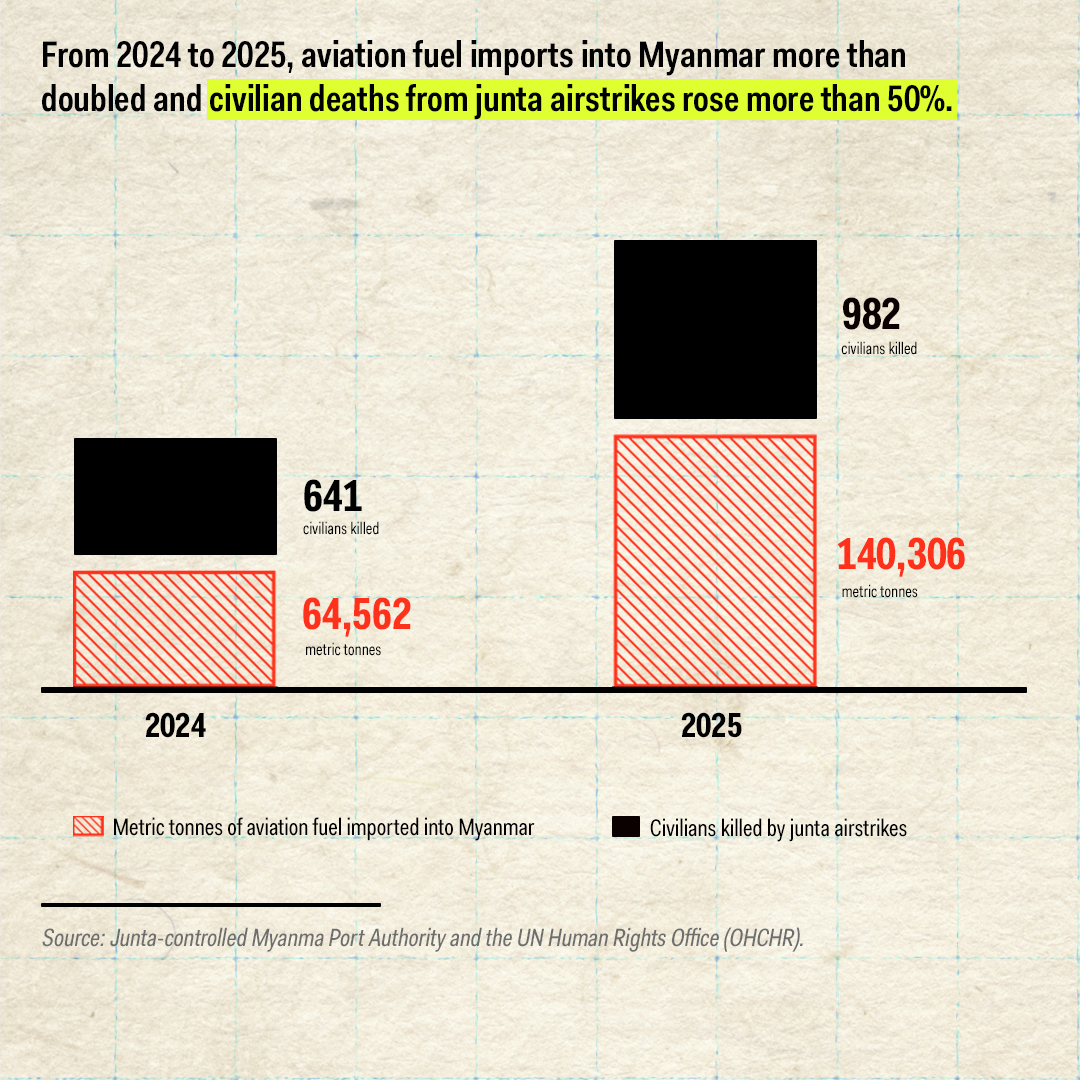
As junta airstrikes have increased, so have aviation fuel imports. Data published by the Myanma Port Authority, which is illegally under junta control, shows that jet fuel imports to Myanmar more than doubled between 2024 and 2025, from 64,562 metric tonnes to 140,306 metric tonnes.
This deadly supply chain must be stopped.
Justice For Myanmar has welcomed all rounds of US, UK, EU, Canadian and Australian sanctions targeting the junta’s aviation fuel supply chain since they began in 2023. However, the junta’s rebranding, the slow pace of sanctions and the lack of a coordinated, networked approach have created dangerous gaps. The result is that the policy objectives of existing sanctions are severely undermined.
Sanctions urgently need to be expanded. That must involve updating sanctions imposed on the junta’s State Administration Council to ensure its rebranded executive, legislative and judicial structure and its members remain designated, and extending sanctions to targets not yet designated. For instance, the junta’s commerce minister Tun Ohn, who is responsible for overseeing international trade for the junta, including aviation fuel, is not yet sanctioned in any jurisdiction. Tun Ohn’s ministry also oversees the export of lucrative commodities that fund international crimes, notably oil and gas, timber, jade and gems. He is also a member of the FESC. The FESC chairperson, Nyo Saw, is the junta’s “vice-president-1” and a long-term member of the junta’s National Defence and Security Council. Despite his notoriety and senior role in the junta, Nyo Saw is sanctioned only by the EU and Canada, while the FESC as a body has not been sanctioned by any jurisdiction. Sanctions gaps must be closed to block the junta’s continued access to funds, aviation fuel and arms.
The junta controls the aviation fuel supply chain in Myanmar and diverts shipments for military use. There is no way to prevent aviation fuel supplied to Myanmar from fuelling airstrikes, and the only solution is a comprehensive ban. To date, only Canada has moved to ban the export, sale, supply and shipment of aviation fuel and provision of shipping insurance for aviation fuel to Myanmar. Other governments must follow Canada’s lead and implement similar bans. In addition, the USA, UK, EU, Canada and Australia need to coordinate and expand sanctions on the whole network of individuals and entities that continue to supply aviation fuel to the junta, including the junta-controlled entities MPE and NEPAS, and all companies and principals of the Asia Sun group and their associates, including Dynamic Wave, PP Petroleum, Tawan-Oil Trading and NEC Trading.
Asia Sun group has regularly transacted with vessels sanctioned by the USA for trading in Iranian petrochemical products under their former names. In vessel arrival records on file with Justice For Myanmar, two tankers, MT NOBLE (IMO Number 9162928) and MT REEF (IMO Number 9263382), are recorded as carrying aviation fuel to the Myan Oil terminal in 2024 and 2025, including aviation fuel cargoes recorded for Dynamic Wave and PP Petroleum. Since they were sanctioned, both vessels have taken new names and now sail under a Guinea flag that the international shipping database Equasis marks as false. The two vessels are managed by Sea Route Ship Management FZE at the same Hamriyah Free Zone office in Sharjah, UAE, that Equasis lists for both vessels’ registered owners. Sea Route Ship Management is also sanctioned by the USA.
Justice For Myanmar continues to call for wider sanctions against these and all other vessels that carry aviation fuel to Myanmar, along with their owners, and commercial and international safety management managers.
The involvement of a Singapore fuel terminal and the continued Asia Sun corporate presence in Singapore and Thailand contribute to the failure of ASEAN’s implementation of the Five Point Consensus, which calls for the immediate cessation of violence. Singapore and Thailand have a responsibility to ensure companies and individuals in their territory are complying with domestic and international law, respecting the UN Guiding Principles on Business and Human Rights, and not aiding and abetting the war crimes and crimes against humanity committed by the Myanmar junta. The Singapore and Thai governments must block Asia Sun group from doing business in their territories and accessing their banks, and investigate whether the junta and Asia Sun have used fraudulent means to import aviation fuel through their jurisdictions. Singapore and Thailand must change course, protect their financial and trading systems from the junta, stop the flow of aviation fuel and ensure full accountability for breaches of domestic and international law.
The fact that Asia Sun is doing business in the UAE and has used a company there as seller raises concerns about their access to the UAE and the potential use of Emirati banks in the junta’s aviation fuel supply chain. Some of the vessels recorded carrying aviation fuel to Myanmar are also managed from the UAE by a US-sanctioned company in Sharjah, whose office address is recorded for the vessels' registered owners. Justice For Myanmar calls on the UAE to stop the flow of aviation fuel to Myanmar from its territory and strengthen measures to protect its territory and banks from actors undermining its respective regulatory, financial, and trade systems.
Justice For Myanmar additionally calls on South African authorities to ensure that no aviation fuel is supplied from its territory to Myanmar and investigate whether the junta or those acting on its behalf are falsely naming South Africa as the origin of aviation fuel.
Governments must stop awarding the junta false legitimacy, which only prolongs the Myanmar crisis.
International businesses must cut ties with the junta’s aviation fuel supply chain
Companies, including banks, maritime insurance providers, fuel terminals and shipping firms, need to take proactive steps to ensure they play no role, knowingly or unknowingly, in supplying aviation fuel to Myanmar, or risk aiding and abetting the junta’s ongoing commission of war crimes. This must include heightened due diligence on fuel exports to Myanmar, ensuring that the pricing and density match the commodity listed in shipping documents.
Corporate actors face increasingly complex risks. Fraudulent behaviour in aviation fuel supply chains can become an existential threat, through sanctions exposure, breaches of money laundering regulations and directors’ legal responsibilities, failures of transparency in corporate reporting, or the loss of insurance coverage and bank guarantees.
The junta’s documented methods of commodity misdescription and misclassification demonstrate how the aviation fuel supply chain is evolving. The international response must also evolve to counter tactics of sanctions evasion and break the junta’s deadly aviation fuel supply chain.

FESC letter to NEPAS, November 2025: Download PDF
Sale contract between Dynamic Wave and Tawan-Oil, November 2025: Download PDF
Sale contract between Dynamic Wave and Tawan-Oil, May 2025: Download PDF
Proforma invoice issued by Tawan-Oil to Dynamic Wave, May 2025: Download PDF
FESC letter to NEPAS, February 2025: Download PDF
PP Petroleum letter to junta trade department, January 2025: Download PDF
PP Petroleum letter to junta trade department, December 2024: Download PDF
Documentation for PP Petroleum's import from NEC Trading, December 2024 and January 2025: Download PDF
Tawan-Oil liquidation filings: Aug. 2024 (PDF) | May 2025 (PDF) | Oct. 2025 (PDF) | May 2026 (PDF) | August 2026 (PDF)
Tawan-Oil application for dissolution and liquidation, August 2024: Download PDF
Tawan-Oil registration changes: Download PDF
Tawan-Oil financial statements: 2020 (PDF) | 2021 (PDF) | 2022 (PDF)
Do you also believe that the people of Myanmar deserve to live with freedom, peace and dignity? We can use your help.
We’re looking for partners in the press to collaborate on reports, and advocacy groups to amplify campaigns to dismantle the Myanmar military cartel.
Contact us to learn more
Security is something we take seriously. Emails sent with Proton Mail accounts are end-to-end encrypted.
