


ASEAN Regional Forum drone workshop risks boosting Myanmar junta's capabilities for aerial attacks against civilians
September 17, 2026
The illegal Myanmar junta is set to be invited to an ASEAN Regional Forum (ARF) workshop on preventing and countering the use of unmanned aircraft systems (UAS, also known as drones) for "terrorist and illicit purposes", according to Justice For Myanmar sources with knowledge of the plans. According to the same sources, the workshop will be organised in 2026 or 2027, at a date yet to be announced, and will be co-chaired by Australia, Singapore and the USA as an activity under the ARF's Inter-Sessional Meeting on Counter-Terrorism and Transnational Crime. The meeting would bring together officials of ARF member states in areas that include law enforcement and border security to learn about UAS technology, increase capacity, and develop national frameworks and strategies to counter-UAS use by those designated as "terrorists". The organisers consulted the illegal junta on the activity concept in June.
As documented by UN investigators, the Myanmar junta continues to ramp up its campaign of indiscriminate airstrikes across the country. The UN Human Rights Office has reported that airstrikes were the leading cause of civilian casualties in 2025. It recorded 982 civilians killed by airstrikes, among them 368 women and 232 children, a 52% increase compared to 2024. The UN Human Rights Office has also confirmed 2025 to be the deadliest year for children in Myanmar since the illegal coup attempt.
As part of its aerial campaign of terror, the junta has rapidly expanded its use of UAS, motorised paragliders and gyrocopters capable of delivering munitions at low altitude. In its July 2025 report on drone warfare in Myanmar, Armed Conflict Location & Event Data (ACLED) counted more than 570 military drone strikes "against resistance groups and civilians" in at least 340 locations. ACLED attributes at least 191 deaths to these strikes and identifies at least 158 of the dead as civilians.
Junta-operated UAS have been used in attacks targeting civilian infrastructure including schools and places of worship, in blatant violation of international humanitarian law. The Myanmar junta has also used UAS to deliver improvised chemical weapons. Free Burma Rangers reported that on December 7, 2024, the junta used drones to disperse aluminium phosphide, a highly toxic fumigant and insecticide, in the Moe Bye area in southern Shan State. International law prohibits the use of toxic substances as a method of warfare when they are employed to cause death or harm through their toxic properties.
The junta has expanded its drone warfare by replicating techniques pioneered by resistance groups, adapting commercially available UAS to drop munitions, and assembling its own systems from off-the-shelf components.
Inviting the junta to the ARF workshop would therefore present a foreseeable and significant risk of unintended technology transfer to the junta. The inclusion of the Myanmar junta by the ARF, a multilateral dialogue platform, also falsely legitimises and further emboldens the junta while continuing to undermine ASEAN's credibility.
Justice For Myanmar demands that the ARF bar the junta from the workshop, and that ASEAN exclude the junta from all meetings and events, including those related to defence and policing.
ASEAN-led ARF workshop on UAS and counter-UAS systems
The ARF is a key platform for political and security cooperation and dialogue in the Asia-Pacific region, initiated and led by ASEAN which chairs its annual ministerial meetings.
Counter-terrorism and transnational crime have been a significant part of the ARF's areas of cooperation, and remains a key priority area as laid out in its cooperation framework for the next decade. Cooperation in this area is coordinated under the ARF Inter-Sessional Meeting on Counter-Terrorism and Transnational Crime, a body established in 2002 through a concept paper drafted by the USA and Malaysia. The ARF adopted the Manila Plan of Action (2026–2036) in July 2026 during the 33rd meeting of the ARF in the Philippines, attended by the illegal junta's “Permanent Secretary of the Ministry of Foreign Affairs”. At the same meeting, Singapore was confirmed as Chair of the 34th ARF for the 2026–2027 inter-sessional year, the period in which the workshop is expected to be held.
Within this context, a workshop under the ARF's counter-terrorism cooperation framework has been proposed to address the risks of terrorist acquisition and use of consumer and industrial grade unmanned aircraft systems for so-called malicious purposes, and to identify ways to counter the free cross-border movement of readily available UAS technologies, according to Justice For Myanmar sources. The workshop will focus on the techniques, tactics and procedures that illicit actors use to employ consumer-grade UAS, counter-UAS systems and manage their border security.
According to Justice For Myanmar sources, the target participant profiles for the workshop include working level practitioners in policymaking, law enforcement, civil aviation authorities, border security forces and international experts.
In Myanmar, "law enforcement" is carried out in the limited areas under the junta’s effective control by the Myanmar Police Force under the junta-controlled Ministry of Home Affairs. In May 2022, the illegal junta introduced the “Myanmar Police Act”, which brought the police under the direct command of the military. The UN Human Rights Office records that the measure allowed the police to be deployed as auxiliary forces in military operations relating to national security and defence and allowed officers to make arrests without a warrant.
The Myanmar Police Force has been directly involved in the violent suppression of peaceful demonstrations, including the use of live ammunition, and in the arbitrary arrest and detention of protesters following the attempted 2021 coup. UN investigators have documented people being arbitrarily targeted in police operations, disappearing after being stopped at police checkpoints, and subjected to acts amounting to torture or ill-treatment while held in police stations. Border security forces of the junta include the Border Guard Police, a notorious force under the junta's Ministry of Home Affairs. In a 2018 report, the UN Independent International Fact-Finding Mission on Myanmar found that the 2017 "clearance operations" against the Rohingya were led by the Myanmar military, with other security forces, mainly the Myanmar police force and the border guard police.
The Myanmar Police Force is not the only part of the junta’s Home Affairs Ministry that is mobilised to repress the people of Myanmar. Other departments include the Bureau of Special Investigation, Prisons Department and General Administration Department, which together comprise the backbone of the junta's institutional instruments that are deployed to systematically target, surveil and imprison democratic resistance movement actors of Myanmar. As a result, the junta's home affairs minister Soe Htut and his deputy Than Hlaing have been sanctioned by the EU, the UK,the USA and Canada. Subsequently sanctioned junta ministers and deputy ministers have also held the post. Ni Lin Aung, already sanctioned by the EU over the Christmas Eve 2021 Mo So massacre in Karenni State, was made deputy junta home affairs minister and police chief in July 2023. Nyunt Win Swe, sanctioned by the EU and Canada, was appointed home affairs minister in April 2026 in the junta’s most recent rebrand.
The Myanmar military junta's participation in ASEAN counter-terrorism initiatives is particularly alarming given how it has weaponised counter-terrorism for use against Myanmar’s democratic resistance movement actors, human rights defenders, civil society groups and humanitarian actors. UN human rights bodies, including a group of UN Special Rapporteurs and the Office of the United Nations High Commissioner for Human Rights, have repeatedly noted how the junta applies "terrorist" designations in an overly broad and politically motivated manner. A feature of the military junta's terror campaign has been its labelling of Myanmar’s legitimate National Unity Government, People’s Defence Forces and Ethnic Resistance Organisations (EROs) as "terrorists". The language of counter-terrorism is also used heavily in junta propaganda, which routinely portrays resistance-controlled territories as spaces dominated by "terrorists" or "extremists", a narrative that attempts to justify aerial and ground attacks that intentionally and deliberately targets civilians and weaponises access to humanitarian aid.
Notably, as reported by Australia in a response to a freedom of information request by Justice For Myanmar, the Myanmar military has used ASEAN's defence counter-terrorism working group to give speeches trying to justify its own campaign of terror against civilians as “counter-terrorism”, and to press ASEAN-Plus partners to adopt a meeting record characterising the National Unity Government and its affiliates as terrorist groups. Similarly, the junta has used the ARF's annual publication to demand that ASEAN members oppose groups that the Myanmar military has designated as “terrorist organisations”, which include democratic resistance movement actors.
Clear and unacceptable risks of knowledge transfer
Structured technical exchanges on component selection, systems integration and manufacturing processes under the guise of “disrupting the cross-border movement” of UAS technologies and parts will enhance both the technical knowledge and operational capabilities of the military junta. This risk is particularly acute given the junta's documented efforts to overcome international restrictions on its access to arms, dual use goods and technology through the domestic adaptation of commercially available components.
Photographic evidence and reporting on UAS operated by the junta indicate that the military has adopted designs and practices closely aligned with those used by resistance forces, particularly the modification of commercially available drones to deliver munitions. In 2024, the junta began procuring thousands of Chinese commercial drones and modifying them to carry locally made munitions. Alongside these adapted commercial platforms, the military has also developed and assembled its own UAS, including one-way attack drones, using designs and systems built largely from commercially available, off-the-shelf components.
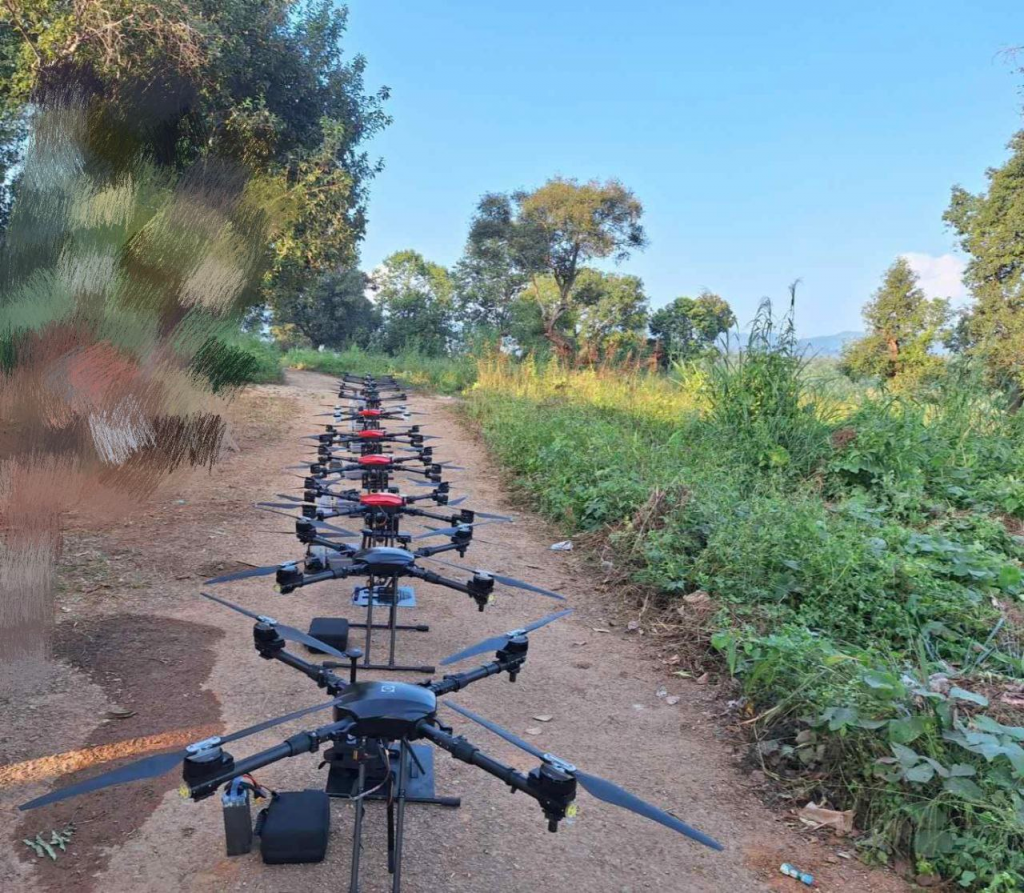
The junta is also reportedly locally manufacturing PVC piping filled with gunpowder for use in its drones, possibly because of a shortage of components.

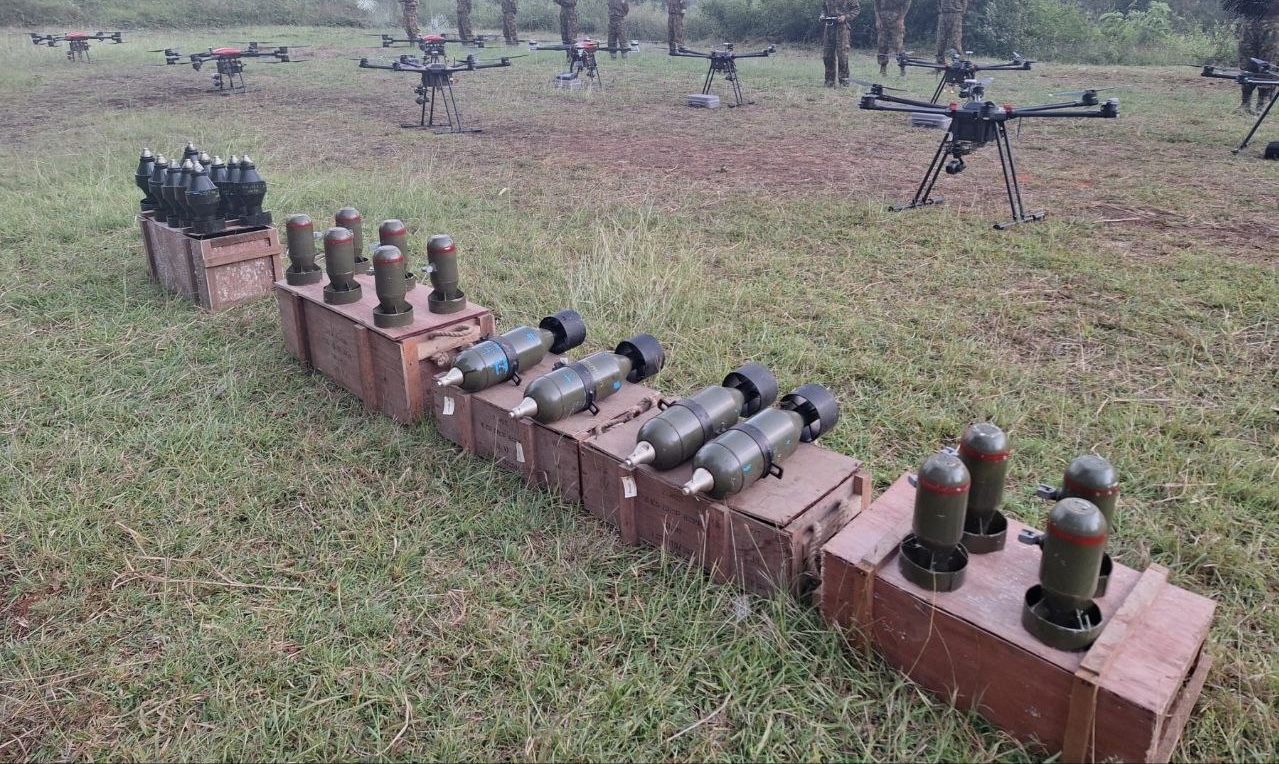
Following resistance breakthroughs driven by access to commercially available UAS, the junta has also pivoted to starving the resistance movement of drone parts while scaling up its own modified drone fleet. Notably, during a junta deputy minister’s visit to China in September 2024, the junta reportedly requested that Beijing block the export of dual-use items and drone parts to resistance groups. The junta is also reported to have ordered the arrest of individuals selling and importing dual-use items domestically in an effort to block resistance forces’ access to UAS components.
Inviting representatives of the junta to a UAS workshop would strengthen its UAS capabilities. Exposure to demonstrations of UAS architecture, component selection, supply chains, manufacturing techniques, payload integration, and counter-UAS systems would give the junta practical options for further developing its own domestic capabilities. It would also help the junta identify which commercially available components are suitable for particular applications, how those components could be combined into functioning systems, and where equivalent components may be sourced. A workshop intended to provide ostensibly general technical knowledge would therefore have consequences beyond its immediate training objectives and risks aiding and abetting the Myanmar junta’s international crimes.
Against this background, UAS and counter-UAS tools are not neutral in Myanmar. The illegal junta uses these tools to crush the democratic resistance movement at all costs, while intentionally targeting civilians as a form of collective punishment.
Condemning the junta's violence while hosting the perpetrator
The inclusion of Myanmar military junta representatives in a UAS workshop would be fundamentally at odds with the public positions on Myanmar of the co-organisers, Australia and the USA.
Both governments have already refused to participate in defence meetings and activities with the junta. In 2022, the USA and Australia withdrew from the ASEAN Defence Ministers' Meeting-Plus Experts' Working Group on Counter-Terrorism, which the Myanmar and Russian militaries were co-chairing. The US Department of Defense confirmed that the two co-chairs had used their positions "to propagandize and justify the atrocities they are continuing to commit against innocent people". In 2023, Australia, New Zealand and the USA declined to participate in the tabletop exercise held in Myanmar and the associated field training exercise in Russia. In October 2022, the Australian government told the Senate that neither the Minister for Foreign Affairs nor the Minister for Defence would attend a workshop in Brunei for the ASEAN Defence Ministers' Meeting-Plus Experts' Working Group on Military Medicine, of which Australia was a co-host, citing a policy of reducing contact with the Myanmar junta to essential engagement only.
The Australian government has said it holds grave concerns about the ongoing political and humanitarian crisis in Myanmar. It has condemned the Myanmar military junta’s human rights abuses and violations, and expressed deep concern over the junta’s ongoing attacks against civilians, including by means of airstrikes.
In 2023, the USA strongly condemned the junta's killing of civilians, in particular the continued use of airstrikes, and reaffirmed the need to respect international law and protect civilians.
In 2023, following the airstrike by the Myanmar Air Force on civilians in Pa Zi Gyi, Sagaing, Singapore's Foreign Affairs Minister Vivian Balakrishnan said that "any attack on civilians is reprehensible and cannot be condoned", and expressed his condolences to the families of the victims. Singapore has also repeatedly called for the permanent cessation of violence as part of the implementation of the ASEAN Five-Point Consensus, to which Min Aung Hlaing and the military junta have shown total contempt. In response to a 2023 report published by the UN Special Rapporteur on Myanmar, exposing Singapore-registered entities as a significant source of arms for the junta, Singapore also commented that it has "taken a principled position against the Myanmar military's use of lethal force against unarmed civilians".
Singapore has also taken measures to reduce its exposure to the junta’s arms and military equipment supply chains. Following the Special Rapporteur's report, a 2022 Justice For Myanmar investigation, and the #DoMoreSingapore campaign urging the Singaporean government to block the Myanmar junta's access to arms and dual use goods, there was a reported significant fall of nearly 90% in exports of weapons and related materials to Myanmar from Singapore-registered companies in the year ending March 2024. In addition, over half of the Singapore-registered companies identified by Justice For Myanmar in 2022 as suppliers of weapons, dual use goods and technology to the Myanmar military have now been struck off Singapore's national registry.
Each of the UAS workshops’ three co-organisers of the workshop have therefore stated, in their own words, that the junta's attacks on civilians are unacceptable. Convening a UAS workshop with the participation of the Myanmar junta would set a dangerous precedent. It would not only undermine the co-organisers principled positions on Myanmar but also embolden the junta to continue committing war crimes and crimes against humanity in blatant violation of international law.
Ban the junta from ASEAN
It is unacceptable that ASEAN continues to provide a platform for the illegal military junta to legitimise itself. The UAS workshop is only the most recent example of ASEAN's failure to resolve the crisis in Myanmar. While Min Aung Hlaing and his “Foreign Minister” continue to be excluded from ASEAN Summits and official Foreign Ministers' Meetings, ASEAN and its defence partners have worryingly maintained deep and sustained contact with the military junta at multiple levels. Justice For Myanmar demands that ASEAN immediately stop granting false legitimacy to the junta and ban it from all ASEAN meetings and activities.
The co-chairs of the UAS workshop, Singapore, the USA and Australia, must commit to fully excluding the Myanmar military from the workshop to ensure that counter-terror assistance is not diverted toward repression. As the ASEAN member state co-organising the workshop, as ARF Chair and as incoming ASEAN chair in 2027, Singapore has a heightened responsibility to uphold its public commitments and to ensure that ASEAN does not further aid and abet the Myanmar junta's international crimes.
Justice For Myanmar calls on ARF members to immediately strip the junta of funds, weapons, equipment, technology and aviation fuel, and to block its attempts to falsely gain legitimacy. To ensure long-term safety and security for Myanmar and the region, the ARF and its members must reject the illegal junta and stand firmly with the people of Myanmar, who have bravely resisted the criminal junta for over five years in pursuit of a federal democratic future.

Do you also believe that the people of Myanmar deserve to live with freedom, peace and dignity? We can use your help.
We’re looking for partners in the press to collaborate on reports, and advocacy groups to amplify campaigns to dismantle the Myanmar military cartel.
Contact us to learn more
Security is something we take seriously. Emails sent with Proton Mail accounts are end-to-end encrypted.
